
From the EU to North America, from Southeast Asia to the Middle East—what certifications and test reports do your tiles actually need to enter these markets? One article clears it up.
【About Us】
We are a Foshan-based tile manufacturer with over a decade of production history—well-established in the domestic market, now expanding to serve international buyers directly. Our factory operates multiple production lines with an annual capacity of several million square meters. Before we started exploring export, our products were already widely used in commercial complexes and residential developments across China.
We’re new to export, but we’re not new to tile manufacturing. And we’re investing heavily in getting the export side right—from compliance and certification to packaging and logistics.
For many factories, the first export order comes down to pricing. But securing repeat orders, accessing formal distribution channels, and winning large-scale projects depends on one thing: compliance.
Here’s a reality often overlooked: the biggest risk in tile export is not a failed price negotiation—it’s when the shipment arrives at the destination port and the compliance documents don’t meet local standards. The result? Stuck customs clearance. Rejected installation. Even forced return shipping.
This is not an exaggeration. The EU market requires CE marking. The North American market requires compliance with ANSI/ASTM standards. And while Southeast Asian and Middle Eastern markets have relatively looser enforcement, large-scale projects and government procurement are increasingly demanding third-party test reports.
This article breaks down: which certifications each market actually requires, what these certifications validate, and what documents you as a buyer should request from your supplier.
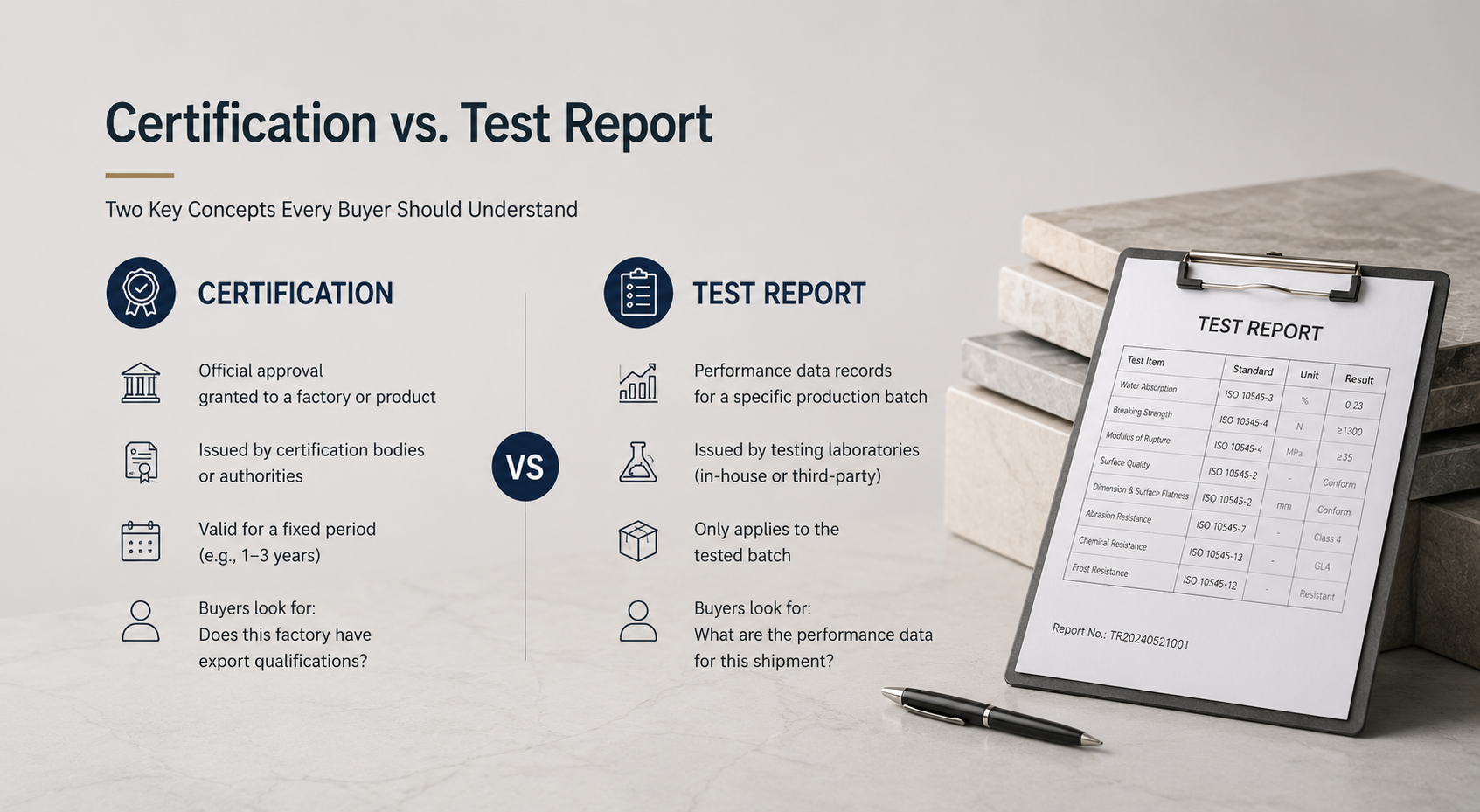
Part 1: Two Concepts to Clarify First—Certification vs. Test Report
In the tile industry, the term “certification” often gets thrown around to mean two very different things. Many misunderstandings between factories and buyers start right here.
| Certification | Test Report | |
|---|---|---|
| What it is | Official approval granted to a factory or product, confirming compliance with a standard | Performance data records for a specific production batch |
| Issued by | Third-party certification bodies (SGS, TÜV, BV, etc.) or official authorities | Testing laboratories (in-house or third-party) |
| Validity | Typically fixed validity period (e.g., 1-3 years), requires renewal | Only applies to the tested batch, does not represent all batches |
| What buyers look for | “Does this factory have export qualifications?” | “What are the specific performance data for this shipment?” |
In actual procurement practice:
-
-
First-time cooperation: Buyers request certificates (proof that the factory has export qualifications)
-
-
-
Every shipment: Buyers require third-party test reports (proof that this specific batch meets standards)
-
-
-
Large orders: Buyers may also arrange on-site inspection (visual verification)
-
So: certification is the entry ticket; test reports are the ongoing requirement. Both are essential.
Part 2: Certification Requirements by Major Export Market—Detailed Breakdown
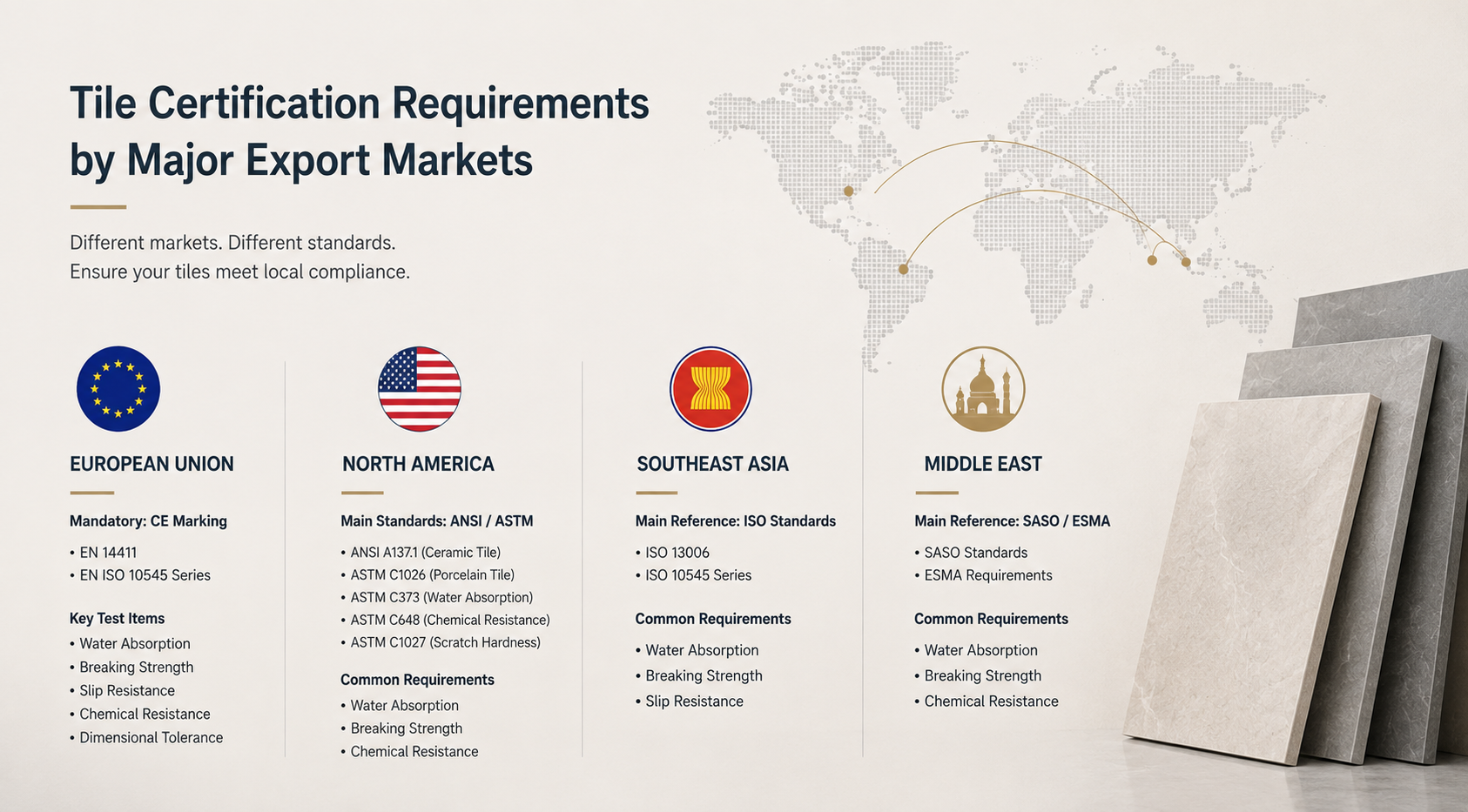
1. European Union (EU) — CE Marking + EN Standards
The EU market has the most stringent and systematic requirements for tiles.
Mandatory requirement: CE Marking
Under the EU Construction Products Regulation (CPR, Regulation (EU) No 305/2011), tiles as construction products must bear the CE mark when exported to the EU market. CE marking is not a “quality certification”—it is a declaration that the product meets EU health, safety, and environmental protection requirements.
For tiles specifically, the applicable standards are:
| Standard | Title | What It Covers |
|---|---|---|
| EN 14411 | Classification and requirements for ceramic tiles | Water absorption, breaking strength, modulus of rupture, dimensional tolerances |
| EN ISO 10545 Series | Test methods for ceramic tiles | Detailed test methods across 16 parts |
The CE certification process:
-
-
Factory produces according to EN 14411 standards
-
-
-
Engage a Notified Body or accredited laboratory for testing
-
-
-
Factory prepares a Declaration of Performance (DoP)
-
-
-
Affix CE marking and prepare technical documentation
-
Advice for buyers:
-
-
Request both the CE certificate and the corresponding DoP document
-
-
-
Verify that the performance indicators listed in the DoP match the actual product
-
-
-
Confirm that the factory name and address on the CE certificate match the supplier
-
Common misconception: CE certification operates on a “self-declaration” basis—theoretically, factories can test and declare compliance themselves. However, professional buyers typically do not accept self-declaration alone. They expect test reports issued by Notified Bodies or recognized third-party laboratories (SGS, TÜV, etc.) as the basis for CE compliance.
2. North American Market (US, Canada) — ANSI + ASTM Standards
The North American market does not require CE marking but has its own comprehensive standards system.
Core standards:
| Standard | Title | What It Covers |
|---|---|---|
| ANSI A137.1 | American National Standard for ceramic tile | Water absorption, breaking strength, crazing resistance, stain resistance, chemical resistance, etc. |
| ASTM C373 | Water absorption test method | Water absorption, apparent porosity of ceramic tiles |
| ASTM C1028 | Static coefficient of friction test | Slip resistance (though DIN 51130 is increasingly preferred in recent years) |
Characteristics of the North American market:
-
There is no single unified “certification mark,” but large-scale projects (government works, commercial chains) typically explicitly reference ANSI A137.1 in tender documents
-
Buyers focus more on specific product test reports than on factory-level certifications
-
For slip resistance, North America has increasingly been referencing the DIN 51130 (R-rating) standard in recent years, rather than the domestic ASTM standard
Advice for buyers:
-
Request third-party test reports confirming compliance with ANSI A137.1
-
Pay special attention to slip resistance indicators—for wet-area projects, ask whether the supplier can provide DIN 51130 test results
-
Confirm whether tile dimensions match North American conventions (imperial units, e.g., 12″×24″ vs. metric 300×600mm)
3. Southeast Asian Market — No Mandatory Certification, but Third-Party Test Reports Are Increasingly Important
The Southeast Asian market (Singapore, Malaysia, Indonesia, Thailand, Philippines, Vietnam, etc.) currently has no mandatory tile certification requirements.
However, the landscape is evolving:
-
Singapore: The Building and Construction Authority (BCA) has clear quality requirements for building materials. Large-scale government projects typically require third-party test reports.
-
Malaysia: SIRIM certification is not mandatory, but having it gives products a competitive edge in government projects.
-
Other markets: As local building standards rise, more and more projects are requiring suppliers to provide ISO certification and third-party test reports.
What Southeast Asian buyers typically look for:
| Test Item | Reference Standard | Note |
|---|---|---|
| Water absorption | ISO 10545-3 | Porcelain tiles must be ≤ 0.5% |
| Breaking strength | ISO 10545-4 | ≥ 1800 N for thickness ≥ 7.5mm |
| Slip resistance | DIN 51130 or ASTM C1028 | R10 or higher recommended for wet areas |
| Dimensional tolerance | ISO 10545-2 | Check for consistency across tiles |
Advice for buyers:
-
Request ISO 9001 quality management certification—a basic proof of standardized factory management
-
Request third-party test reports with every shipment—SGS, Intertek, or Bureau Veritas are all acceptable
-
For government projects, confirm in advance whether local certification (e.g., Malaysia SIRIM) is required
4. Middle East and Other Markets — EU Standards Referenced
The Middle East (UAE, Saudi Arabia, Qatar, etc.) and African markets do not have independent tile certification systems but commonly reference EU EN standards.
-
Many Middle Eastern project tenders directly state “complies with EN 14411”
-
Local distributors typically require suppliers to provide CE certification or test reports from recognized laboratories such as SGS
-
Saudi Arabia has been strengthening product compliance requirements in recent years—while tiles are not currently subject to mandatory SABER certification, it is advisable to confirm the latest regulations before exporting
Advice for buyers:
-
Prepare CE certification and EN standard test reports—these are widely accepted in the Middle East
-
For large-scale projects, confirm in advance whether local certification is required
Part 3: Certification Requirements by Market — Quick Reference Table
| Market | Mandatory Certification | Common Requirements | Recommended/Plus Certification | Notes |
|---|---|---|---|---|
| EU | CE Marking | EN 14411 + DoP | ISO 9001 | Notified Body reports carry more weight |
| US | No unified mandate | ANSI A137.1 + ASTM tests | ISO 9001 | DIN 51130 recommended for slip tests |
| Canada | No unified mandate | ANSI A137.1 / CSA standards | ISO 9001 | Québec may have additional requirements |
| Singapore | No mandate | Third-party test reports | ISO 9001 | Government projects require BCA acceptance |
| Malaysia | No mandate | Third-party test reports | SIRIM certification | SIRIM adds value for government projects |
| Indonesia/Thailand/Vietnam | No mandate | Third-party test reports | ISO 9001 | Markets rapidly standardizing |
| Middle East | Varies by country | EN standard test reports | CE certification | Check latest Saudi SABER requirements before exporting |
Part 4: 5 Practical Steps for Buyers to Verify a Supplier’s Compliance Capability
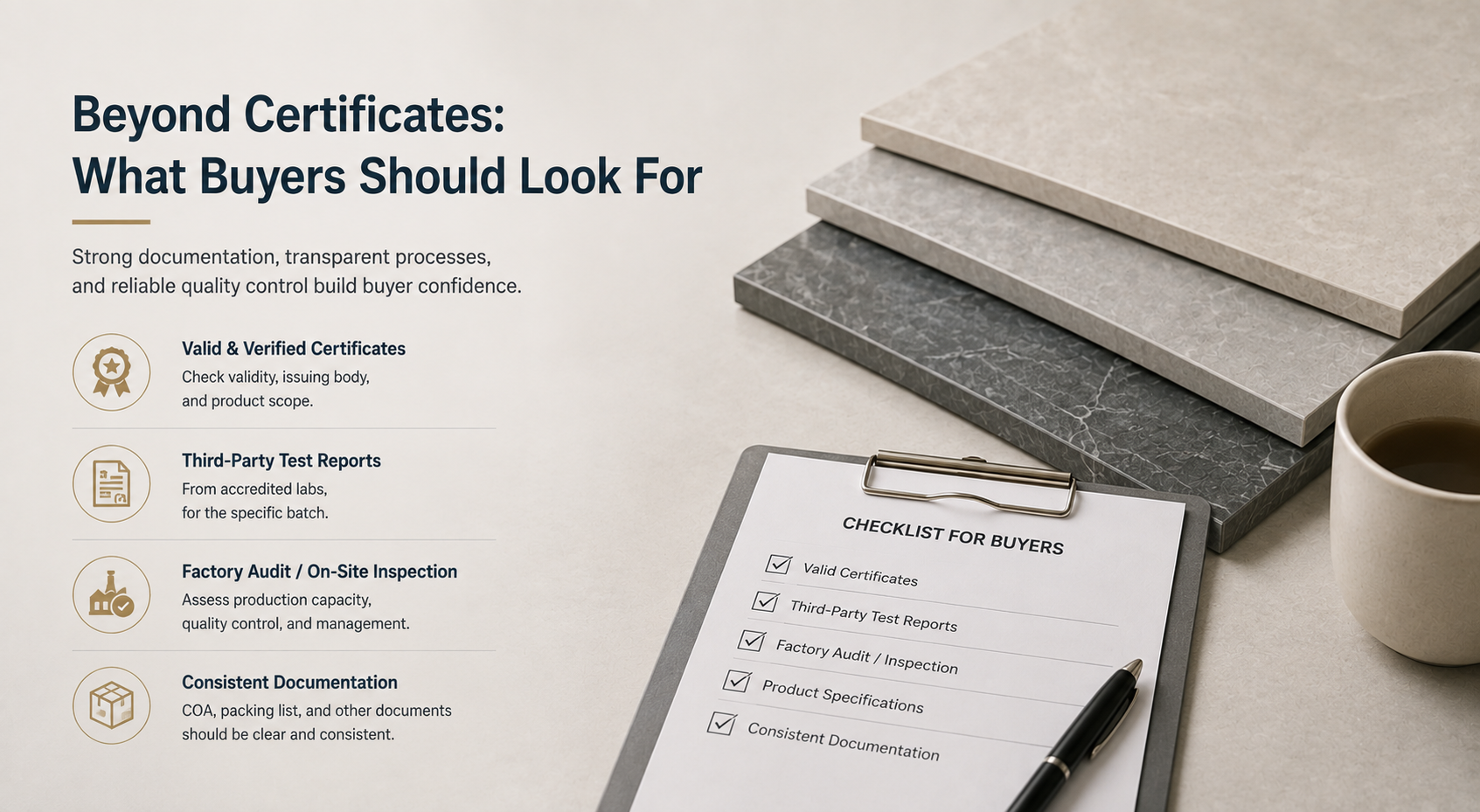
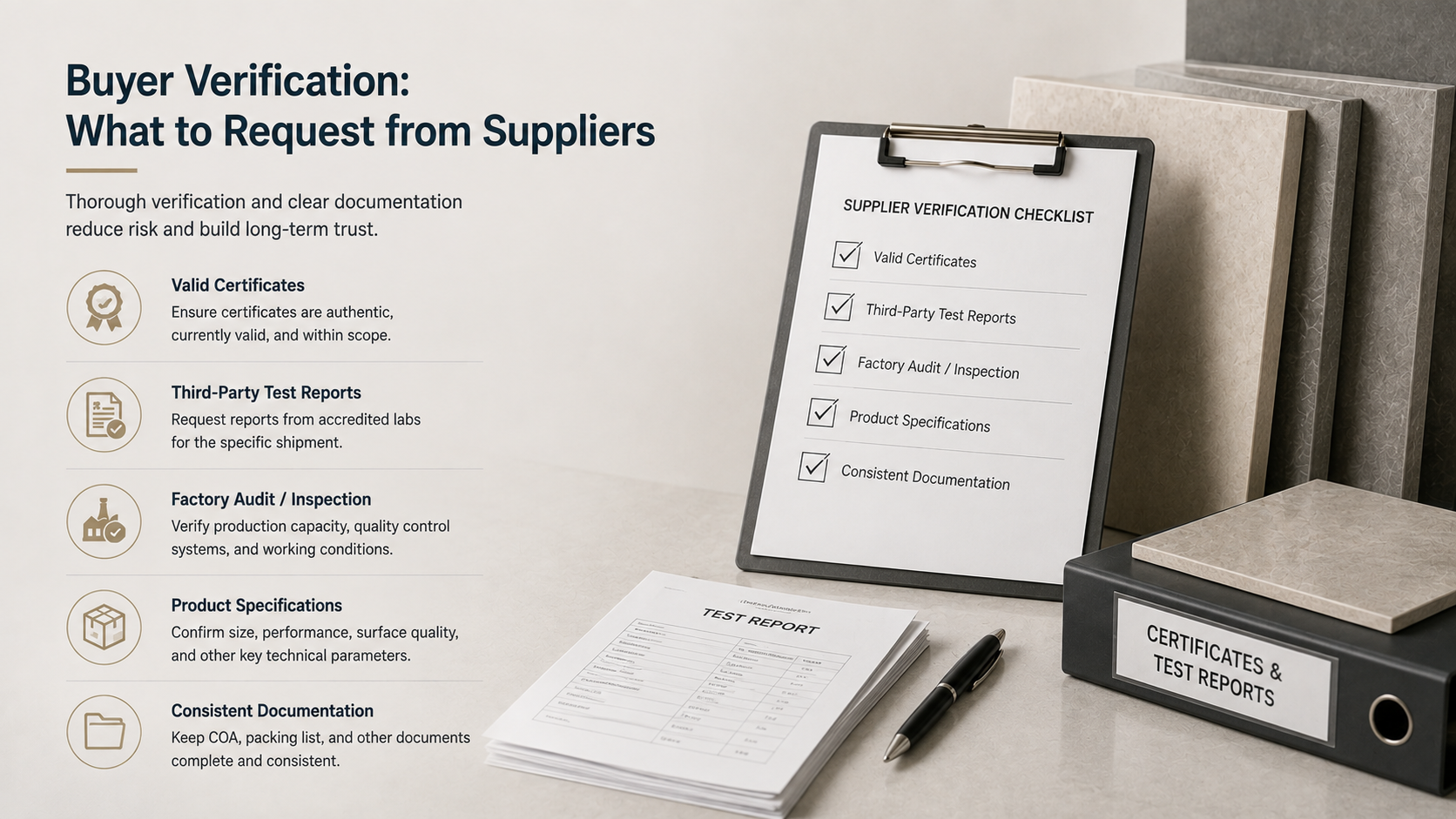
If you are a buyer, here is a quick method to assess whether a factory is truly export-ready:
Step 1: Request a certification list
Ask directly: “What export certifications do you have? Can you provide scanned copies of the certificates?”
-
 Quick provision with verifiable certificate info → positive signal
-
 Vague or delayed responses → caution warranted
-
 “Do we need certifications for export?” → clear lack of export experience
Step 2: Verify certificate validity
-
Check whether the factory name and address on the certificate match the supplier (some traders use others’ certificates)
-
Check the certificate’s expiry date — expired certificates are as good as none
-
Verify the certificate number through the issuing body’s official website
Step 3: Request sample shipping documents
A legitimate export-ready factory should be able to provide standard document templates:
-
Packing List
-
Commercial Invoice
-
Certificate of Origin
-
Test Report
If a supplier cannot even produce standard templates for these documents, their export process likely has not been fully established.
Step 4: Understand the factory’s quality control process
Ask these questions:
-
“How do you control water absorption in daily production? How often do you conduct random sampling?”
-
“How do you manage shade/color control? How do you ensure consistency across batches?”
-
“Do you accept third-party inspection?”
The depth of responses will clearly differentiate experienced factories from inexperienced ones.
Step 5: Start with a small trial order
No matter how complete the certifications and reports look, always start with a small trial order for the first shipment:
-
Verify whether actual product quality matches the reports
-
Verify whether delivery lead times are met
-
Verify whether communication runs smoothly
Once the trial order passes, then scale up—this is the safest procurement strategy.
Part 5: For Factories Preparing for Export Certification — Recommended Starting Path
If your factory currently does not hold any international certifications, here is a step-by-step approach from zero:
Step 1: Start with ISO 9001 Quality Management Certification
This is the most fundamental, cost-effective, and globally recognized certification. It does not apply to any specific product but demonstrates that “the factory has a standardized production management process.” ISO 9001 is the management system certification most easily recognized by international buyers worldwide.
Step 2: Conduct full-performance testing of your products (preferably to EN 14411 or ANSI A137.1 standards)
Engage an internationally recognized third-party laboratory such as SGS, Intertek, TÜV, or Bureau Veritas to conduct comprehensive testing on your mainstream products. At a minimum, cover:
-
Water absorption
-
Breaking strength
-
Modulus of rupture
-
Dimensional tolerance
-
Slip resistance (preferably with DIN 51130 R-rating)
Once you have this test report in hand, even without a CE mark, you can demonstrate to buyers that “our products have been tested by a third party and the data meets standards.”
Step 3: Initiate market-specific certifications based on your target markets
-
Targeting the EU → Start CE certification process (engage a Notified Body such as TÜV, SGS, or BV)
-
Targeting the US → Complete test reports to ANSI A137.1 standards; consider UL certification (though not mandatory, it adds value for engineering tenders)
-
Targeting Singapore → Prepare ISO 9001 + third-party test reports
Important note: The above recommendations are based on current industry practices. Specific certification requirements may vary by product type and the latest regulations of the target country. We recommend confirming details with local importers or professional certification consultants before formally initiating any certification process.
【Supplier Verification Checklist — Our Response】
In response to the 5-step buyer verification process outlined in Part 4, here is our current status:
| Verification Step | Our Status |
|---|---|
| Provide certification list | We have mapped out certification requirements for our target export markets (EU/ North America/ Southeast Asia) and are currently in discussions with certification bodies, prioritizing applications sequentially. A complete certification roadmap is available upon request. |
| Certificate validity verification | All existing domestic certifications (e.g., CCC, ISO 9001) are complete and within validity. Export certifications are in the application process; proof of application progress can be provided at any time. |
| Sample shipping documents | Standard export document templates (Packing List, Commercial Invoice, Certificate of Origin, Test Report) have been prepared and can be adapted to meet destination market requirements. |
| Quality control process | Our QC system is built on years of domestic production experience, covering the full process: raw material inspection → in-line sampling → finished product grading → shade/color management. Export order QC standards are implemented on top of our domestic standards, overlaid with international requirements and specific client specifications. |
| Trial order verification | Small trial orders are welcome (samples starting from 2㎡ or flexible small-batch quantities). Buyers are welcome to verify through physical testing. |
Resources for Buyers
Request our certification roadmap — understand our certification application plans and timeline for different target markets
Request a sample test report — see the format and data items from our SGS testing report
Consult on specific export requirements — if you’re unsure what certifications your target market requires, feel free to reach out
Sample orders available — for your internal testing and verification
The certification information in this article is compiled based on current industry standards and trade practices, and is for reference purposes only. Specific certification requirements may vary due to changes in the latest regulations of the target country. We recommend confirming with local importers or professional certification bodies before actual export.